
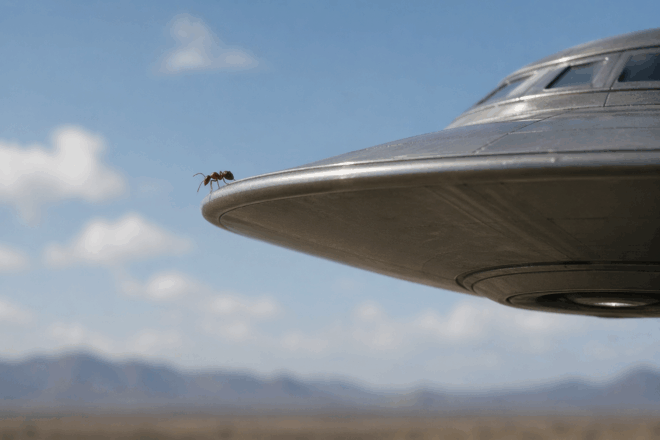
Avi Loeb, the esteemed Harvard Astrophysicist, recently expressed a preference to listening to “imaginative science fiction writers” rather than second-class scientists. I agree with him. The deeper into the Disclosure movement we advance, the more I revisit episodes of the original Star Trek, pondering the human dynamic in learning that man is not the top of the evolutionary food chain.
One is reminded of the film Creature from the Black Lagoon which debuted in 1954. Hollywood took this first crack at discussing evolution as a natural process of speciation. It was quite a roll of the dice in a country where Creationism had dominated the conversation for almost two centuries. Today, evolution is taught in schools across the world; but there remain religious zealot holdouts who still think the Earth is 6,000 years old; adhering strictly to a book written by fallible men from a more primitive time. These are like the second-class scientists that Mr. Loeb laments. Both groups follow the mantra “If it’s not in the book(s), it cannot be so.” They believe it is all “settled science.”
Discoveries are being made in places like the southwest United States, Egypt, and so many more, where carbon dating puts the age of artifacts as far back as 12,000 years or more; predating even the Younger Dryas. Archaeologists who have spent decades of their lives invested in belief systems created by their predecessors are also falling into this trap, mocking alternative historical theories as nonsense. Well, the evidence is accumulating, and science needs to catch up.
As Darwin updated the bible, so may it be necessary for our generation to update Darwin. In the Creature from the Black Lagoon, Dr. Reed says: “One day spaceships will be moving from Earth to other planets. How will human beings live on them? The atmosphere is different. Pressure is different. By studying these, and other species, we add to our knowledge of how life evolved. How it adapted to this world. Then maybe we can help man adapt to the new world of the future.”
The phrase “this world” resonates if one considers that this world may have been a destination for many “seed” species from other worlds. So many may just be the by-product of genetic engineering.
A new hypothesis is emerging, devoted to the notion that many of the organisms on this planet may not have evolved from the Devonian soup, but rather, may have been nudged along by extraterrestrial visitors. To coin a phrase, this is called Extraterrestrial Phylogenetic Alteration, or EPA. Bob Lazar in telling his story in the docudrama “S4” mentions the fact that human DNA may have been edited as many as 65 times by visitors from other worlds or dimensions. What about the other Earth creatures? Would ETs be so self-centered so as not to dabble with the DNA of all of the Kingdoms on this planet, i.e. Animalia, Plantae, Fungi, Protista, Archaea and Bacteria?
Over the last decade revelations about UFOs, SFOs, UAPs and extraterrestrial visitation are finally being acknowledged. The work of Hynek, Valle, Puthoff, Davis and so many more is being liberated from the vault of history. Man, in his egocentric analyses, prefers placing the emphasis on the effects of extraterrestrial interaction on himself. Rarely does the conversation involve other organisms apart from mutilated cattle. Science must consider the possibility that in addition to evolution, an enormous percentage of life may have been gene edited along the way through this type of “hyper-evolution.”
Scientists have for many years charted evolution through phylogenetic transitions. The fossil record offers us many opportunities to look back in time and see “gradual” changes in phenotypic traits. What is more difficult to do is to take prehistoric DNA and make comparisons to the DNA of creatures inhabiting the earth today. Prehistoric DNA is almost impossible to recover, even if you stumble on a mosquito preserved in Amber. DNA has a half-life of approximately 520–521 years, meaning it fragments and becomes unreadable after about 1–2 million years. If you are fortunate enough to find a frozen Mammoth or Mastodon, you may have a shot. However, the odds of creating a complete DNA map of a Tyrannosaurus rex are next to nil.
Consider the idea of Receptospherism, or the complete sensory universe of a living organism - the full spectrum of signals, stimuli, and environmental cues that the organism is biologically equipped to detect, perceive, and respond to, encompassing every receptor type, sensory modality, and detection mechanism available to that life form. Why do various organisms perceive objects, food, movement, even magnetism and energy in different forms? How did their organs and receptors “evolve”? Could they have been nudged along? Could the DNA sequences supporting these functions simply have been inserted at a certain point in time by an extraterrestrial scientist?
Light’s role in exploring EPA is of particular interest. We as humans can see white light and its subcomponents, Red, Orange, Yellow, Green, Blue, Indigo and Violet. If we span the cosmos with our telescope, we can find stars in many of these colors (except Green, Indigo and Violet). There are red giants; blue giants and super giants; yellow suns, yellow super giants and hyper giants; and white dwarves. What if certain segments of DNA from Earth’s organisms have their origins in the DNA of ET life, where perception developed based on the light and electromagnetic energy emitted by its planet’s nearest star?
Vision is just one “sense” to consider from the spectrum of receptors for stimuli. Consider the color red for a moment, with wavelengths spanning 620–750 nm. Plants utilize Red as the optimum wavelength for photosynthesis. It is highly absorbed by chlorophyll in this process. Flowering and Fruiting are heavily red dependent. Yet when we examine our sun, we find that it is not a Red Giant. In fact, it is unlikely to become red for hundreds of millions of years. Could this proclivity to red have been “imported” into earth bound plants in the form of DNA snippets and gene strands from other worlds? Could intelligent beings from other worlds foresee that white light contained the red bandwidths, and as a result could sustain plant life? Could plants in general have been an invasive species brought here by an interstellar traveler? Stowed away in the hold of a UAP? invisible on the shoe of an intergalactic traveler when it stepped into water and voila! Plankton!
Going further we find UV, Blue and Green are commonly visible to arthropods like Lobsters, butterflies and scorpions. Orange is perceptible by birds and a large group of fish. Dogs, Cats and Horses see in a mix of Blue and Yellow, while green perception is typical to Wild Hogs, Boars, Deer Coyotes and foxes. Not to mention, there are those creatures that venture further into the electromagnetic spectrum that may use infrared, such as certain vipers, boas, pythons, vampire bats, mosquitoes, and bullfrogs.
There is a point for my march through the colors of the spectrum. Can it be that creatures such as arthropods developed originally on other worlds? Were certain organisms deposited here because there was adequate foodstuff to sustain their existence, along with the proper wavelengths of light for them to see their prey?
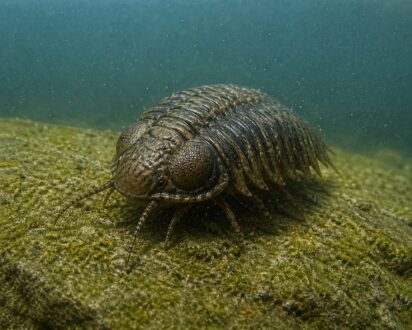
The earliest fossilized arthropods, Trilobites, have been found in Cambrian deposits. Trilobites saw rapid emergence during the “Cambrian explosion.” One suggestion is that Trilobites potentially evolved from a legless creature called a Parvancorina about 521–530 million years ago. Judging by its curved shape, one considers the strong argument tying a Parvancorina evolutionarily to a Trilobite. What if a superior intelligence introduced some DNA into this creature to give it legs? Or better still, what if just brought one from another planet? Could the Trilobite explosion really be attributed to a potential DNA alteration?
It is theorized that Parvancorina consumed suspended organic material, particles of detritus and plankton using external cells or small “jaw-like” structures. Trilobites are also believed to have been detritivores but are also described as a wide variety of marine scavengers that ate smaller invertebrates, bivalves and echinoderms such as starfish. Herbivores became Carnivores and proliferated in one short evolutionary step. One cannot dismiss the possibility that this was engineered by extraterrestrial intelligence, and that the abundance of food (lots of prey) assisted in the explosion of the trilobite population.
One cannot disregard that around the same time the trilobite found its legs and became a carnivore, Earth saw the emergence of vertebrates; a locus in time approximately 530 million years ago. Granted a million years is a long time when the human life cycle lasts maybe 100 years. It’s the different evolutionary events occurring all around the same time that are a cause for reflection. Did Visitors from another star system nudge vertebrates and arthropods along? What other creatures may have hyper-evolved?
The Natural History Museum offers this thought on its website on the Cambrian Explosion: “It means that rather than there being a long and protracted evolutionary explosion throughout the period, it was more of a quick spurt at the start, during which all the major animal body plans came into being. The results finally settle an evolutionary quandary that plagued even Darwin himself, as it questioned his idea that evolution occurred gradually over time. It shows that startlingly fast evolutionary rates can indeed happen, as it did during the start of the Cambrian.”
“Startlingly fast” evolutionary rates or ET assisted Hyper-Evolution? “Came into being” or engineered on a nucleic acid level? I’ll let you decide.
The Earth’s primordial seas may have served as the chemistry lab for extraterrestrial intelligence as far back as 530 million years ago. These experiments may have been performed at other points in Earth’s history. ET visits may have promoted Hyper-evolution at other concentrated moments such as the Great Ordovician Biodiversification Event about 485–460 million years ago; and the Post-Permian Recovery roughly 250 million years ago. Whether ET assisted or occurring gradually over time, we are the beneficiaries of the millions of species that make up this Earth, our own biodiverse world.